No.252 Pinglong East Road, Fenghuang Community, Pinghu Street, Longgang District, Shenzhen +86-18029030625 [email protected]
No.252 Pinglong East Road, Fenghuang Community, Pinghu Street, Longgang District, Shenzhen +86-18029030625 [email protected]

Modern outdoor recreation, remote fieldwork, and emergency preparedness increasingly demand reliable electricity far beyond the reach of conventional wall outlets. While heavy-duty portable generators serve high-wattage residential backup, carrying a bulky 10-kilogram power bank for a weekend coastal trip, photography shoot, or mobile workstation is impractical. Enter the 100W Portable Power Station—an ultra-compact, versatile micro-grid engineered to bridge the gap between pocket-sized USB power banks and heavy off-grid storage units.
As a premier professional manufacturer deeply rooted in the lithium battery industry, YABO Power brings over two decades of specialized expertise to the research, development, and advanced manufacturing of high-performance energy solutions. Backed by state-of-the-art, large-scale production facilities equipped with automated assembly lines and rigorous multi-stage quality control, we deliver world-class Lithium Iron Phosphate (LiFePO4) and Lithium-ion energy systems to partners across Europe, the Americas, Asia-Pacific, and Oceania.
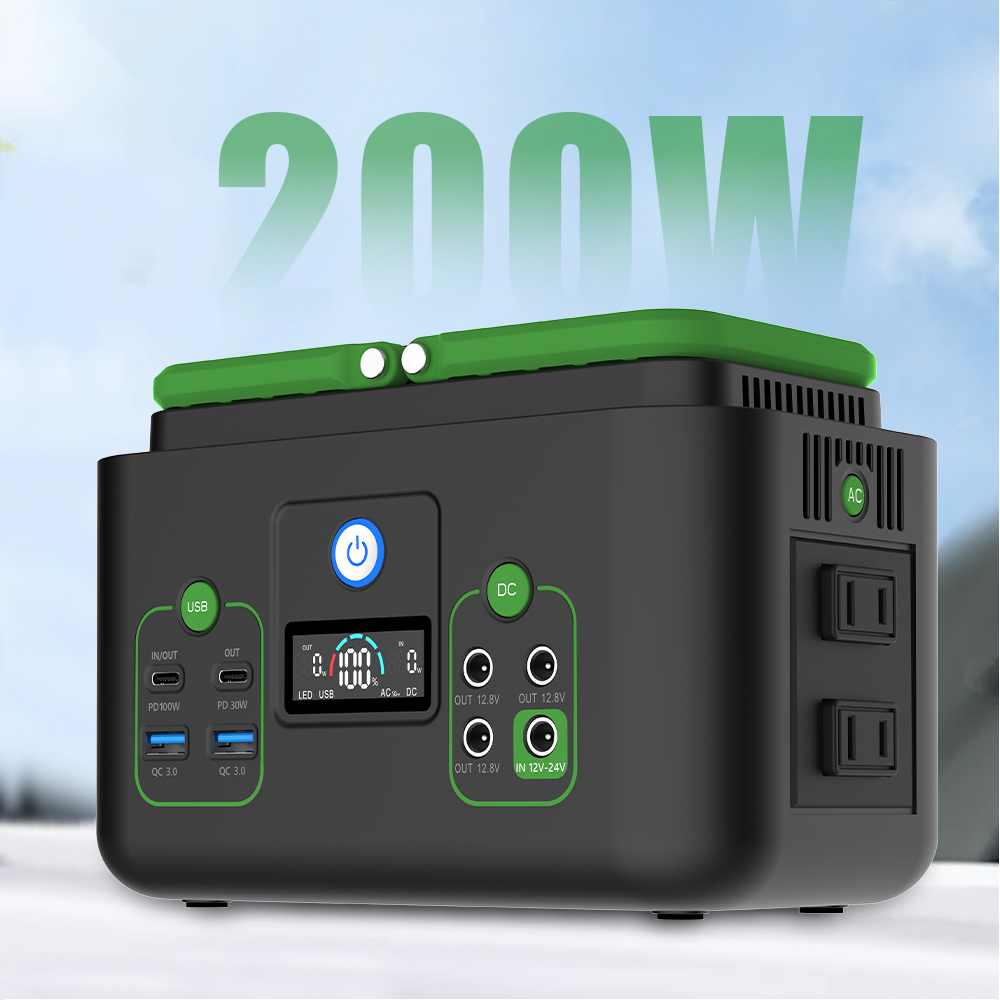
Drawing from the design architecture shown in our compact outdoor deployment unit, this guide explores the technical principles behind 100W portable power stations, key engineering features, real-world runtime calculations, and global OEM/ODM customization opportunities.
Unlike standard smartphone power banks that only output low-voltage DC current (typically 5V to 20V), a true portable power station integrates a complete micro-energy ecosystem inside a rugged, ergonomic enclosure. Understanding three core technical pillars helps explain how a compact 100W unit powers diverse electronics safely:
To run standard plug-in devices—such as laptop power bricks, camera battery chargers, drones, and portable fans—the internal DC battery energy must pass through an inverter to become Alternating Current (AC).
Modern mobile gear relies on varied voltage standards. Looking at the front control interface of the YABO 100W unit, the power distribution panel is engineered for simultaneous multi-device compatibility:
Safety and longevity in compact lithium enclosures depend entirely on the internal BMS. Operating as the brain of the power station, the BMS continuously monitors individual cell voltages, charge/discharge currents, and internal thermal gradients. It enforces six critical layers of hardware and firmware protection:
A common misconception among newcomers to off-grid power is confusing Watts (W) with Watt-hours (Wh).
To estimate real-world runtime, engineers apply a standard efficiency formula accounting for inverter conversion overhead (typically ~85% efficiency):
Estimated Runtime (Hours) = [ Battery Capacity (Wh) × 0.85 ] ÷ Device Wattage (W)
Typical Device |
Average Power Draw |
Estimated Usage / Recharges (on ~100Wh Class Unit) |
Smartphone (12–15Wh battery) |
10W – 20W |
5 to 7 full charges |
Mirrorless / DSLR Camera Battery |
10W – 15W |
6 to 8 full charges |
Ultrabook / Business Laptop |
45W – 65W |
1.3 to 1.8 full charges |
Drone Intelligent Flight Battery |
40W – 60W |
1.5 to 2 full charges |
LED Camp Lantern / Strip Light |
5W – 10W |
8.5 to 17 hours continuous |
Portable Wi-Fi Router / Hotspot |
8W – 12W |
7 to 10 hours continuous |
Note: High-draw heating appliances such as hair dryers, electric kettles, or space heaters (typically 800W–1500W) exceed the 100W continuous threshold and will automatically trigger the BMS overload protection to keep the unit safe. The application scenarios listed in this table may not be fully adapted to this 100W portable power station, for reference only!
Portability means little if an enclosure cannot withstand dust, coastal humidity, or accidental drops during transit. The physical architecture of 100W Portable Power Station prioritizes field durability and ergonomic handling:
For distributors, outdoor lifestyle brands, and industrial equipment integrators, sourcing reliable portable power stations requires partnering with a factory that controls core battery technology from the cell level upward.
At YABO Power, combining over 20 years of battery manufacturing heritage with flexible, end-to-end OEM/ODM engineering capabilities allows us to transform complex client specifications into market-ready commercial products:
As remote work, eco-tourism, and decentralized energy adoption continue to expand globally, compact 100W portable power stations represent one of the fastest-growing segments in consumer and light-commercial energy storage.
Whether you are an international distributor expanding your renewable energy catalog, an outdoor brand launching a private-label power line, or a system integrator seeking dependable off-grid power modules, YABO Power delivers the engineering precision, factory-direct scalability, and proven reliability your business demands.
Explore Full Specifications & Start Your OEM/ODM Project:
Official Website: www.yabopower.com
 Hot News
2026-11-19
2026-10-22
2026-09-29
2026-09-04
2026-08-05
2026-07-06

Shenzhen Yabo Power Technology Co., Ltd. provides custom LiFePO4 battery packs for solar, home energy storage, and industrial applications. 25+ years of expertise, ISO 9001 & CE certified. Trusted by Fortune 500 companies. Request a sample today.
No.252 Pinglong East Road, Fenghuang Community, Pinghu Street, Longgang District, Shenzhen
Copyright © 2026 Shenzhen Yabo Power Technology Co., Ltd. All rights reserved Privacy Policy
 EN