
 EN
EN

The rise of energy independence has pushed off grid power systems from a niche concept into a mainstream infrastructure solution for homes, businesses, remote facilities, and mobile applications. Whether you are powering a rural cabin, a recreational vehicle, a marine vessel, or a commercial operation far from utility lines, understanding the technologies that make these systems work is essential for making informed purchasing and design decisions. Modern off grid power systems are not simply a collection of solar panels and batteries — they are integrated ecosystems of complementary technologies that must work in precise coordination to deliver reliable, efficient, and long-lasting energy.
The pace of technological advancement over the past decade has dramatically improved the performance, affordability, and scalability of off grid power systems. From next-generation battery chemistries that extend cycle life to smart inverter platforms that automate energy management, each component plays a critical role in the overall system's reliability. This article explores the key technologies that define modern off grid power systems, explaining not only what they are but why they matter in practical deployment contexts and how they interact to create a functional, autonomous energy architecture.
Energy Generation Technologies in Off Grid Power Systems
Photovoltaic Solar Power
Solar photovoltaic technology remains the most widely adopted generation source in off grid power systems worldwide. Modern monocrystalline and polycrystalline solar panels have achieved conversion efficiencies that were unimaginable two decades ago, with high-performance monocrystalline modules routinely exceeding 20% efficiency in commercial deployments. This efficiency gain directly reduces the physical footprint required to generate a given amount of power, which is critical in space-constrained installations such as rooftops, vehicle tops, or compact remote facilities.
Beyond raw efficiency, advances in panel durability have made solar a more reliable long-term investment in off grid power systems. Modern panels are rated for 25 to 30 years of operation with minimal degradation, and improvements in anti-reflective coating and tempered glass design have enhanced performance under diffuse light conditions. Bifacial panel technology, which captures both direct and reflected light, is increasingly being integrated into stationary off-grid installations to maximize energy yield from a fixed array surface area.
Charge controllers — specifically Maximum Power Point Tracking (MPPT) controllers — have become an indispensable pairing with solar panels in high-performance off grid power systems. MPPT controllers continuously optimize the electrical operating point of the solar array to extract maximum available power under changing weather and irradiance conditions. Compared to older Pulse Width Modulation (PWM) controllers, MPPT technology can improve solar harvest efficiency by 20 to 30 percent, which represents a substantial gain especially in partially cloudy environments.
Wind and Hybrid Generation
While solar dominates most off grid power systems, wind turbine technology provides a critical complement in locations where solar irradiance is seasonal or inconsistent. Small-scale wind turbines designed for residential and light commercial use have evolved considerably, with permanent magnet alternators and optimized blade geometry enabling energy capture at lower wind speeds. Modern turbines designed for off-grid use typically feature integrated dump load controllers and robust weatherproofing for long-term unattended operation.
Hybrid generation architectures combine solar, wind, and sometimes diesel or propane generators within a single off grid power system. Hybrid systems address the fundamental intermittency limitation of renewable sources by ensuring at least one generation pathway is active at any given time. Sophisticated hybrid controllers manage these multiple inputs simultaneously, prioritizing renewable sources and only engaging backup generators when battery reserves fall below defined thresholds. This approach dramatically reduces fuel consumption while maintaining high system uptime.
Energy Storage Technologies That Define Off Grid Performance
Lithium Iron Phosphate Battery Technology
Battery storage is arguably the most critical technology in any off grid power system because it bridges the gap between generation and demand. Among available battery chemistries, Lithium Iron Phosphate (LiFePO4) has emerged as the leading choice for modern off-grid deployments. LiFePO4 batteries offer a compelling combination of long cycle life, thermal stability, high energy density, and efficient charge and discharge characteristics that make them far superior to legacy lead-acid alternatives in most applications.
A key performance differentiator for LiFePO4 batteries in off grid power systems is their usable depth of discharge. While lead-acid batteries are typically limited to 50% depth of discharge to preserve cycle life, LiFePO4 cells can regularly be discharged to 80 to 90% of their rated capacity without significant degradation. This means that a LiFePO4 battery bank delivers substantially more usable energy per unit of installed capacity compared to lead-acid systems, effectively reducing the battery bank size and cost required to meet a given energy demand.
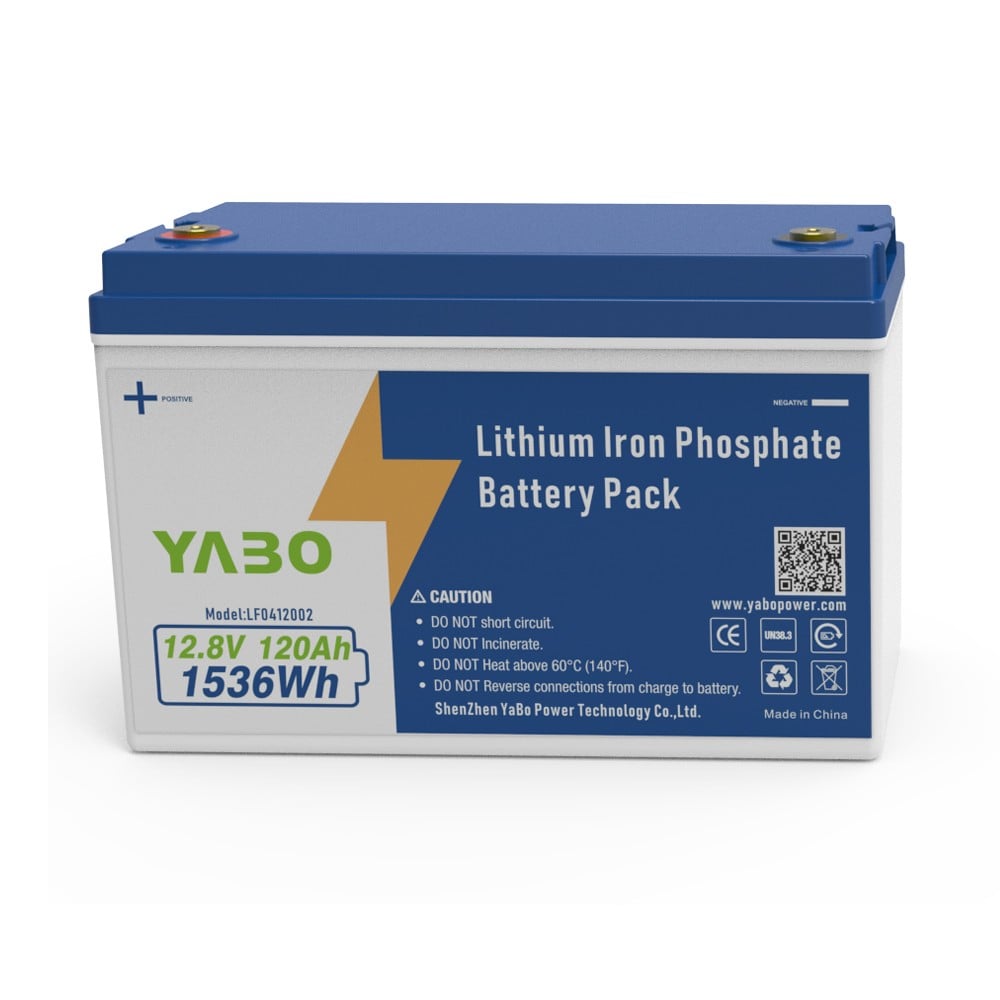
A high-capacity solution like the off grid power systems battery from YABO Power — a 12V 120Ah LiFePO4 deep cycle unit — exemplifies how modern lithium technology delivers the cycle durability, consistent discharge voltage, and broad application compatibility needed in demanding RV, solar, marine, and off-grid environments. The flat discharge curve of LiFePO4 chemistry ensures that appliances and electronics receive stable voltage throughout most of the discharge cycle, improving the performance and longevity of connected loads.
Battery Management System Integration
A Battery Management System (BMS) is the intelligence layer embedded within every modern lithium battery pack used in off grid power systems. The BMS continuously monitors individual cell voltages, state of charge, temperature, and current flow to protect the battery from conditions that would cause damage or accelerated aging. Functions such as cell balancing, overcharge protection, over-discharge cutoff, short circuit protection, and thermal management are all handled automatically by the BMS without user intervention.
The sophistication of BMS technology has a direct impact on the safety and longevity of energy storage in off grid power systems. A well-designed BMS ensures that all cells within a large battery bank age uniformly by redistributing charge between stronger and weaker cells during every charge cycle. This active balancing extends the effective service life of the entire pack well beyond what passive balancing or no balancing could achieve. For mission-critical off-grid installations, BMS quality is a critical selection criterion that should not be overlooked in favor of lower upfront component costs.
Power Conversion and Management Technologies
Inverter and Inverter-Charger Platforms
Inverters convert the DC electricity stored in batteries into the AC electricity required by most household and commercial appliances. In modern off grid power systems, pure sine wave inverters have become the standard choice because they produce clean, grid-quality AC output that is compatible with sensitive electronics, variable-speed motors, and medical equipment. Modified sine wave inverters, while less expensive, can cause noise, heat, and reduced efficiency in many modern devices, making them a poor fit for comprehensive off-grid applications.
Inverter-charger combination units have become a cornerstone technology in sophisticated off grid power systems. These integrated platforms handle DC-to-AC inversion, AC-to-DC charging from generator or grid inputs, and automatic transfer switching within a single unit. The result is a seamless energy management hub that responds intelligently to changes in generation availability, battery state of charge, and load demand without requiring manual intervention. Multi-mode operation — including solar priority, battery priority, and generator backup modes — is now a standard feature in premium inverter-charger platforms.
Smart Energy Management and Monitoring
Advanced energy management platforms represent one of the most transformative recent developments in off grid power systems. These software-driven systems collect real-time data from all system components — solar arrays, batteries, inverters, generators, and loads — and use this data to optimize energy flows automatically. Predictive algorithms that factor in weather forecasts, historical consumption patterns, and battery health metrics can pre-charge batteries before a cloudy period or curtail non-critical loads to protect battery reserves during extended low-generation intervals.
Remote monitoring capabilities have become a standard expectation for modern off grid power systems deployed in commercial, industrial, or unattended remote locations. Cloud-connected monitoring platforms allow operators to view real-time system status, configure operational parameters, receive fault alerts, and analyze performance trends from any internet-connected device. This remote visibility is invaluable for preventing unexpected downtime, planning maintenance interventions, and optimizing system settings across a fleet of distributed off-grid installations.
Structural and Balance-of-System Technologies
Wiring, Overcurrent Protection, and DC Architecture
The electrical architecture supporting off grid power systems — often referred to as the balance of system — encompasses wiring, fusing, circuit breakers, busbars, and disconnects. Proper wire sizing is critical in off-grid DC systems where high currents flow over relatively short distances and even small resistive losses translate into measurable energy waste and heat generation. Correct fusing and circuit breaker selection protects both the wiring and the connected equipment from fault conditions that would otherwise cause fire hazards or equipment damage.
Battery interconnection architecture significantly influences the performance consistency of large battery banks in off grid power systems. Parallel and series configurations must be implemented with careful attention to cable length uniformity and connection resistance balancing to ensure that all batteries in a bank share charging and discharging currents equally. Unbalanced current distribution accelerates the aging of individual batteries and reduces the overall capacity and reliability of the bank, making proper installation technique as important as component quality in achieving long system life.
System Sizing and Scalability Design
Effective sizing methodology is a technology in itself within the domain of off grid power systems. Accurate load analysis, solar resource assessment, battery autonomy calculation, and generator backup sizing must all be performed with appropriate safety margins to ensure that the system meets real-world energy demands under worst-case conditions. Undersizing any component creates bottlenecks that reduce overall system performance and reliability, while oversizing increases capital costs unnecessarily.
Modern scalable architectures allow off grid power systems to grow with evolving energy needs. Modular battery systems, expandable solar array mounting structures, and multi-unit inverter stacking capabilities mean that a system installed today can be economically expanded in the future without replacing core components. This scalability is particularly valuable for commercial and industrial operators who anticipate growing power demands or phased project development timelines.
FAQ
What makes LiFePO4 batteries a better choice than lead-acid for off grid power systems?
LiFePO4 batteries offer a significantly higher usable capacity, longer cycle life typically exceeding 2000 to 3000 full cycles, superior thermal stability, and a much lower self-discharge rate compared to lead-acid batteries. In off grid power systems, these advantages translate into more usable energy per kilogram of battery weight, lower long-term replacement costs, and more consistent performance across a wide range of temperatures and discharge depths. The integrated Battery Management System in LiFePO4 packs also provides automatic protection and cell balancing that lead-acid batteries simply cannot offer.
How important is the MPPT charge controller in an off grid power system?
The MPPT charge controller is extremely important because it maximizes the energy harvested from the solar array under all weather conditions. In a well-designed off grid power system, an MPPT controller can improve solar harvest by 20 to 30 percent compared to a basic PWM controller, particularly in environments with variable cloud cover or during early morning and late afternoon hours when panel irradiance is low. Over the lifetime of the system, this improvement in harvest efficiency directly reduces the size and cost of the battery bank and backup generation required to maintain reliable power supply.
Can off grid power systems power an entire home reliably?
Yes, modern off grid power systems are fully capable of powering an entire home reliably when properly sized and designed. The key requirements are accurate load analysis, sufficient solar or hybrid generation capacity, a battery bank sized to provide adequate autonomy during low-generation periods, and a backup generator for extended poor-weather conditions. Many households worldwide operate entirely on off grid power systems without any utility connection, achieving a high standard of energy reliability through well-integrated technology selection and proper system sizing.
What role does system monitoring play in the long-term performance of off grid power systems?
System monitoring plays a vital role in maintaining the performance and longevity of off grid power systems. Continuous monitoring of battery state of charge, solar generation output, inverter status, and load consumption allows operators to detect anomalies early, before they develop into system failures. Modern monitoring platforms with remote access capabilities are especially valuable for installations in remote or unattended locations, enabling proactive maintenance scheduling and rapid fault diagnosis without requiring on-site inspection for every system event. Over time, monitoring data also supports performance optimization and informed capacity planning decisions.
Table of Contents
- Energy Generation Technologies in Off Grid Power Systems
- Energy Storage Technologies That Define Off Grid Performance
- Power Conversion and Management Technologies
- Structural and Balance-of-System Technologies
-
FAQ
- What makes LiFePO4 batteries a better choice than lead-acid for off grid power systems?
- How important is the MPPT charge controller in an off grid power system?
- Can off grid power systems power an entire home reliably?
- What role does system monitoring play in the long-term performance of off grid power systems?